
Seed Broadcast: Chosen Seeds
An exploration of how imagining seeds – real and invented – can nurture joy, creativity, and healing within carceral spaces through the Seed & Bloom program.
This piece reflects on how imagination can take root even in the most constrained places. Through the Seed & Bloom program at the Penitentiary of New Mexico, I have witnessed how dreaming about seeds—real or imagined—can open space for healing, creativity, and joy inside carceral settings. What follows is a story about one student’s imagined seed and how it continues to shape the work I do today.
I remember sharing the “Chosen Seed” exercise with students a few years ago.
It was 2021, and I was looking at them through a screen, zooming into a classroom at a youth detention center for young women in the Bronx, New York. The exercise invites participants to imagine a seed of their own creation. It can be blue with polka dots, neon green with black stripes, hot pink—anything at all. Once a design is chosen, the next step is to determine the superpower of the seed. In this scenario, the seed would not produce a fruit or a vegetable. Instead, this chosen seed would flourish in ways that grew ideas from which actions could follow.
Until this exercise, one student had been hard to reach. Understandably, she was in a lot of emotional pain and reluctant to participate, especially at such a distance during an already confusing and charged time in the pandemic.
Her chosen seed was neon green and blue. It grew ridiculously long stems, all at the same speed.From these long “stem-arms,” pre-paid cards could be plucked by families and used to purchase food. This special plant, evolving from her chosen seed, would be able to sense when families were more likely to stay indoors due to the cold. In the spring and summer, the cards would hold $120 per family, per season, to use for fresh food like fruits and vegetables. In the fall and winter, the cards would adapt to hold $240 per family, per season. The stems would always remain the same, only the cards would change.
Inside of the hour we had for class, and among so much noise and chaos in the room that this child had to endure, she was talking about access to a simple need: food. In this carceral space, in the center of a food desert, in this cage, this student was imagining a chosen seed that could truly feed and nourish her urban community.
I often think about this student and her wish for a seed so powerful. I think about how what she wished for was something that served ideas far bigger than herself. I think about how her situation has evolved since that time. I hope that she is somewhere safe, that she is thriving as a free, newly established seedling in this world.
I thought about her last night, while packing bins for a Seed & Bloom workshop at the Penitentiary of New Mexico (PNM). Seed & Bloom is a horticulture and culinary arts program for individuals incarcerated at PNM. I created it in May 2024, after eight years of work in carceral spaces.
There are three program areas.
- Nature-based activities rooted in therapeutic horticulture. These include tending to our indoor plants and hydroponics towers where we grow flowers and vegetables inside the prison. They also include sitting under the tree in the courtyard with our students, reading poems, expressing ourselves with the help of hand pup-pets, or creating bottle gardens from upcycled water bottles.
- Our Seed & Bloom farm.We have grown almost 300 pounds of fresh food in four newly restored greenhouses. Our food is sold through the Santa Fe Farmers Market Institute’s Tianguis Móvil truck, which visits communities across the city with the goal of expanding access to fresh and healthy foods.
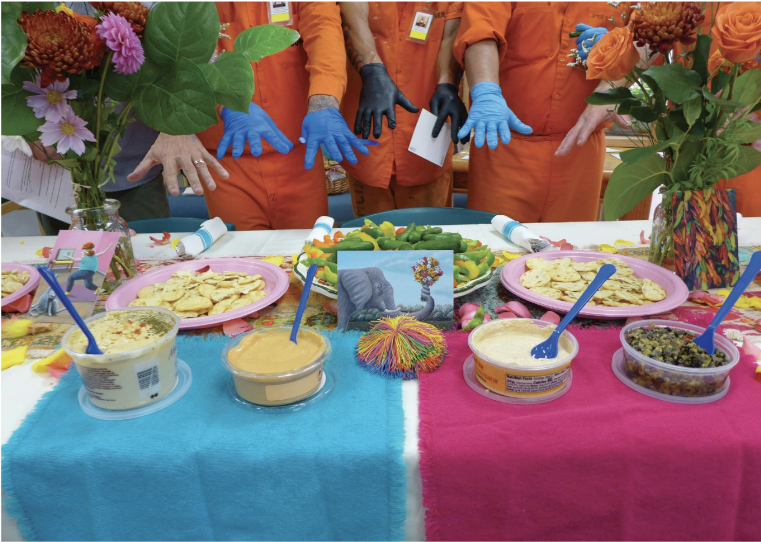
- Culinary workshops. In these, we prepare meals, invite students to look at grocery store prices in realtime, and reflect on questions at the dinner table. These often center on food memories and sensory experiences the kitchen offers. The workshops are two to three hours of teamwork, problem solving, creativity, beauty, and cooking. They are opportunities for our students to turn on a stove for the first time ever, or for the first time in over a decade… and to crack an egg, to identify ginger root for the first time, or to have their first taste of horchata.
For others, it might be tasting a dish requested by a student for his 31st birthday: menudo. The last time he had the dish was when he was 15 years old, which was the last time he was in the free world. Once the cooking is finished, we gather at five tables adorned with tablecloths and student-made floral bouquets. A gratitude blessing is offered.
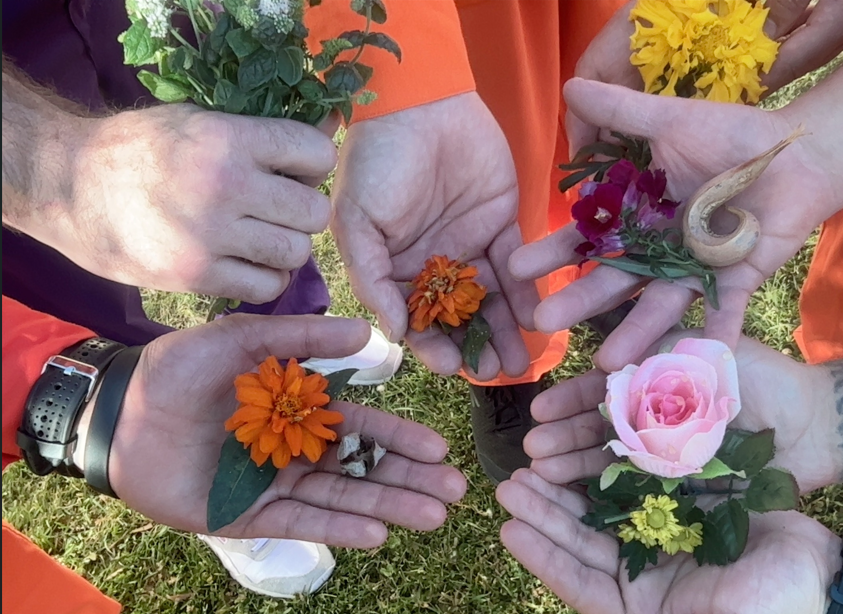
At the maximum-security facility, we have different rhythms. We see two different groups here, and we begin by visiting our garden beds. The walls around us are white and high enough to block the view of the mountains. But in the garden, we have cosmos and marigolds and sunflowers—purple, orange, yellow, and green.
We head inside to the classroom where we tend to our hydroponics towers and indoor plants. Sometimes we look at postcards of complex images and write stories about them-what’s the story we each see? We share what we write aloud. One card showed a blue shirt on a hanger, with a pocket that revealed a room through a window frame. A light was on in the room and there was a plant growing. Other natural objects hung out nearby, but they lived outside of the room and away from the shirt. Our stories had to include all of the objects on the card.
You can imagine that people who will be incarcerated for the rest of their lives, and who have described time as irrelevant, can hold so many complexities around an image like this. We discuss our scenarios for the card while we prepare our lunch, usually chicken wraps with fresh vegetables, fresh fruit, and yogurt.
I think about how Seed & Bloom is the dream of my own chosen seed. The superpower of the program is that it brings joy into spaces that are designed to keep it out. It offers recreational solutions for reentry, sharing the kitchen and the garden as realms that offer comfort in the free world, and showing how goals for those spaces can come in all different sizes. Other times, it helps create new memories in cages that have held the same humans for nearly half a century.
Chosen seeds are living in all of us. We all have the capacity to dream them into existence. To have them anchor us, or to free us, and to help us flourish and even fly.
by GUNJAN KOUL
GUNJAN KOUL (SHE/HER/HERS), IS THE FOUNDER AND DIRECTOR OF SEED & BLOOM, A PROGRAM ROOTED IN NATURE-BASED THERAPEUTIC AND CULINARY ARTS EDUCATION FOR INCARCERATED STUDENTS. HER WORK CENTERS ON CULTIVATING JOY, CREATIVITY, AND BELONGING AS PATHWAYS TO HEALING, WHILE BUILDING BRIDGES BETWEEN CARCERAL AND FREE COMMUNITIES.